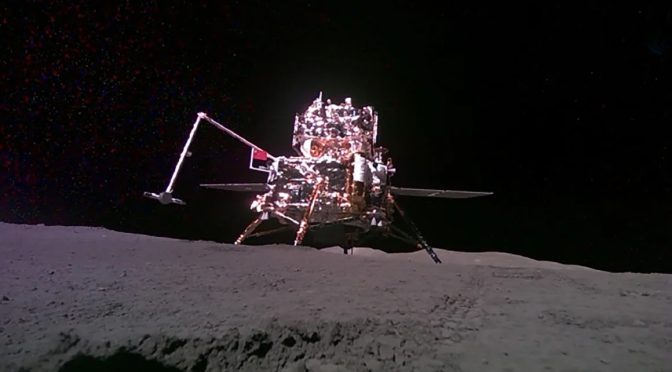
The Chang’e 6 mission of the Chinese National Space Administration (CNSA) has successfully returned the first ever rock and soil samples taken from the farside of the Moon.
The samples are similar to those obtained from the nearside by the Apollo missions back in the 1960s, and other subsequent sample-collection missions. This adds weight to the theory that the Moon was once covered by an ‘ocean’ of molten rock.
The Moon’s farside always faces away from Earth, as the Moon is tidally locked in its orbit. This means that small differences in the pull of the Earth’s gravity at different points across the body of the Moon have acted to slow the Moon’s rotation, since it formed billions of years ago, so it now rotates exactly once on its axis for every orbit it makes around the Earth. This is why the Moon always appear to have the same distinctive face towards us.
The farside was first photographed by the Russian Luna 3 (or Lunik 3) probe in October 1959. This showed far fewer dark maria (or seas) than the Moon’s near side and many more impact craters, due to its exposed outlook facing away from Earth into space.
Chang’e 6’s robotic lander used a scoop and drill to take around 1.9 kilograms of rock and soil samples, on 1 June 2024. These were carried by the ascender module to the mission’s orbiter, on 3 June 2024, which then returned to Earth orbit. The return capsule was recovered from where it landed in Inner Mongolia, on 25 June 2024.
The hole left by the sampling was in the shape of the character zhong (中) – the initial character of China’s name, Zhōngguó 中国, in Chinese script.
The science journal Nature published an article by Q. W. L. Zhang et al, on 15 November 2024, revealing the first results from the analysis of the sample.
The samples show the age of the South Pole-Aitken (SPA) basin – the large crater where the probe landed – is probably around 4.25 billion years, since this is the age of the oldest basalt fragment found in the sample. However, most of the sample material dated from around 2.8 billion years ago.
The 4.2 million-year-old part of the sample is the oldest known example of KREEP basalt, which has only been found previously on Oceanus Procellarum and Mare Imbrium, on the Moon’s nearside. KREEP is a slightly radioactive volcanic rock so named because it is rich in Potassium (chemical symbol K), Rare-Earth Elements and Phosphorus.
The Nature article says that “Mare volcanism on the lunar farside thus persisted for over 1.4 billion years… The consistency between the 2.8-billion-year basalt age and the crater-counting age indicates that the cratering chronology model established for the lunar nearside is also applicable to the farside of the Moon.
The presence of KREEP on the farside seems to disprove a previous hypothesis that, after the Moon formed, a second smaller moon collided with it creating the thicker crust on the farside. Since the farside wouldn’t be expected to contain KREEP under this hypothesis. Much more research will be needed, however.
NASA’s Commercial Lunar Payload Services program (CLPS) will hopefully provide more data in the near future, with three farside exploration missions planned over the next few years.
Micron-sized hematite and maghemite crystals were also found in the samples, created by oxidizing conditions in large impact events.
[Update October 2025] In December 2024, researchers also identified grains of CI chondrite meteorite dust in the soil samples. C refers to ‘carbonaceous’ and I from Ivuna, in Tanzania, where the first such sample was discovered. CI chondrites are rich in water, supporting the hypothesis that asteroids played a role in delivering water and other volatile compounds to the lunar surface.
The photo below was taken by the mission’s robotic rover known as “Jinchan” (Chinese: 金蟾), or “Golden Toad,” due to its gold-sheeted insulating exterior.
The spacecraft itself (which was uncrewed) is named after the Chinese moon goddess Chang’e, and it is CNSA’s sixth robotic lunar exploration mission.

To read more, visit:
https://www.astronomy.com/science/change-6-shakes-up-our-knowledge-of-the-moons-farside/