Category Archives: Uncategorised

Is the Expansion of the Universe Slowing?

New evidence suggesting the expansion of the Universe is slowing down has been published in Monthly Notices of the Royal Astronomical Society, in November 2025.

The new evidence, although unconfirmed, adds weight to the findings from the Dark Energy Spectroscopic Instrument (DESI), near Tucson Arizona, published earlier this year, which also questioned established wisdom about the changing expansion rate of the Universe.

Prior to the DESI publication, it had generally been accepted by cosmologists that the expansion of the Universe is speeding up. In fact, the Nobel Prize for Physics in 2011 was awarded for the observations made in the late 1990s that first showed this accelerating expansion. This led to the theory that a mysterious ‘dark energy’ of unknown origin was driving the expansion of the Universe, possibly at ever increasing rates.

This suggested an indefinite expansion where the Universe becomes cold, dark, and empty as stars die out – a scenario known as the ‘Big Freeze’ or the ‘heat death’ of the Universe. A more violent ending to the Universe was even envisaged, known as the ‘Big Rip’ where the expansion rate accelerates to such a degree that every point in the Universe would become isolated from every other point due to the finite speed of light.

However, the new evidence suggest that from around one billion years ago, this accelerating expansion reversed, meaning the Universe might eventually start to collapse back on itself. If this is extrapolated, the Universe could end up contracting back to a point of near-infinite density, like a reversal of the Big Bang. This scenario is often referred to as the ‘Big Crunch’.

Since the source and full behaviour of dark energy are unknown, it’s possible that the Universe might actually oscillate in size. It’s also possible that the Universe might have undergone many cycles of Big Bangs followed by subsequent Big Crunches over unimaginable timescales.

The evidence from the 1990s for an accelerating expansion was based on observations of supernovae in distant galaxies. Since theories of how these supernovae form suggest they should be of consistent brightness, it was considered possible to use this to determine their precise distance from Earth. Combining this with the supernovae’s redshift (a phenomenon predicted by Einstein’s Special Theory of Relativity), which lets us calculate the speed they are receding away from us, allows us to build a model of the expansion rate of the Universe throughout its history. This is because light takes time to reach us from distant galaxies meaning we are viewing these far-away galaxies as the were in the distant past. Contrary to expectations at the time that the expansion of the Universe was slowing down (which was expected due to the influence of gravity) it was found that the expansion rate seemed to be increasing.

However, the latest findings, bases on an alternative way of estimating the distance to 300 galaxies hosting supernovae, suggest that supernovae in the early Universe were fainter, on average, than they are now, due to variations in the properties of stars. This suggests “a time-varying dark energy equation of state in a currently non-accelerating universe”, according to the newly published paper.

What is certain is that more observations will be needed to establish the true nature of dark energy. Instruments like the European Space Administration (ESA)’s Euclid space telescope, launched in 2023, are set to provide more data. Euclid has a wide-field imager designed to create 3D maps of the universe to study dark energy and dark matter. The featured image, below, shows a mosaic of Euclid’s observations published by the ESA in October 2024. See https://www.esa.int/ESA_Multimedia/Images/2024/10/Euclid_s_mosaic_explained

Euclid Mosaic
Mosaic of observations from the ESA’ Euclid space telescope

To read more, visit:

https://www.theguardian.com/science/2025/nov/06/universe-expansion-slowing-not-accelerating-nobel-prize

https://www.bbc.co.uk/news/articles/c4geldjjge0o

For the original paper, published by Junhyuk Son et al, see Strong progenitor age bias in supernova cosmology – II. Alignment with DESI BAO and signs of a non-accelerating universe, Monthly Notices of the Royal Astronomical Society, Volume 544, Issue 1, November 2025, Pages 975–987, https://doi.org/10.1093/mnras/staf1685
First Images from JWST Released

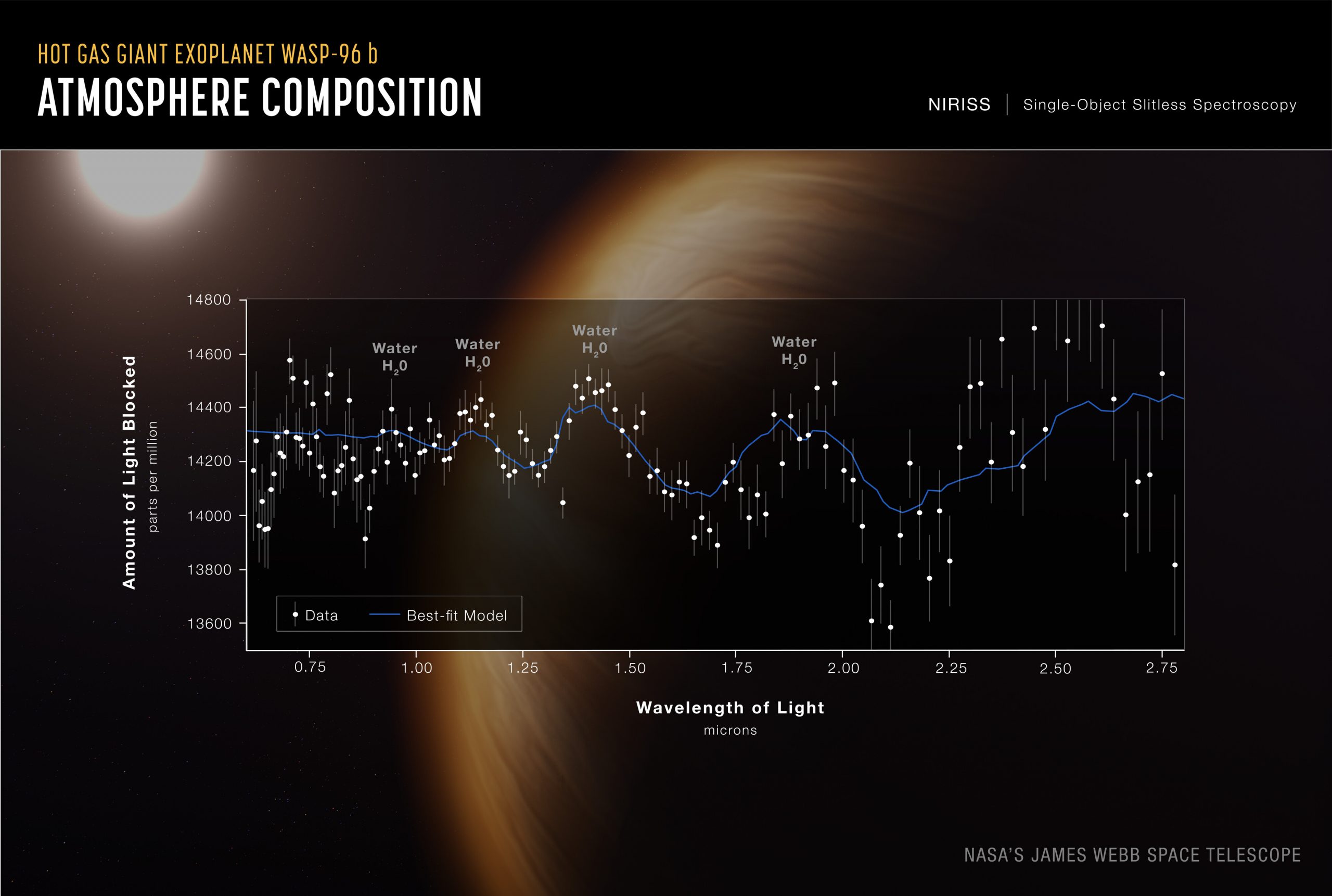
The first full-colour images from the newly commissioned James Webb Space Telescope (JWST) were released on 12 July 2022, providing the deepest ever infrared views of distant galaxies, stunning portraits of the Southern Ring Nebula, Stephan’s Quintet of galaxies and the Carina Nebula, as well as spectographic observations of the exoplanet WASP-96 b, revealing the presence of water.

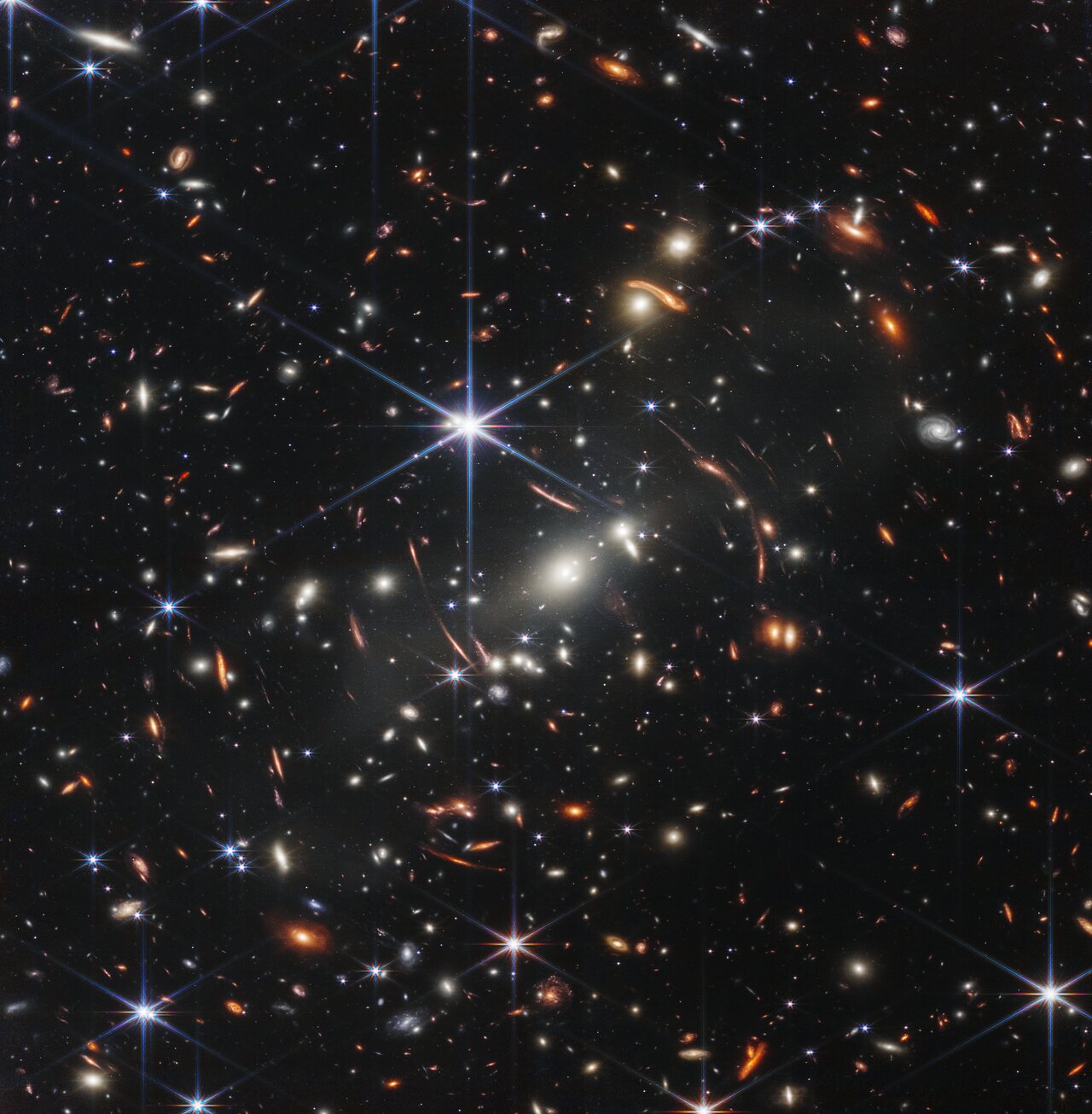
JWST First Image of galaxy cluster SMACS 0723
The first JWST image of distant galaxies in the SMACS 0723 cluster located in the constellation of Volans. The image covers an area of the sky approximately the size of a grain of sand held at arm’s length. The image shows the cluster as it appeared 4.6 billion years ago with many of the galaxies appearing distorted due to gravitational lensing (see General Relativity). (click image to enlarge) Image Credit: NASA, ESA, CSA, and STScI
Southern Ring planetary nebula
JWST Image of the Southern Ring planetary nebula around 2,000 light-years away in the constellation Vela. The image reveals two central stars close together. The dimmer of these two stars is a white dwarf (see Types of Stars) that has blown off its outer layers to form the nebula. (Click image to enlarge). Image Credit: NASA, ESA, CSA, STScI, and the Webb ERO Production Team
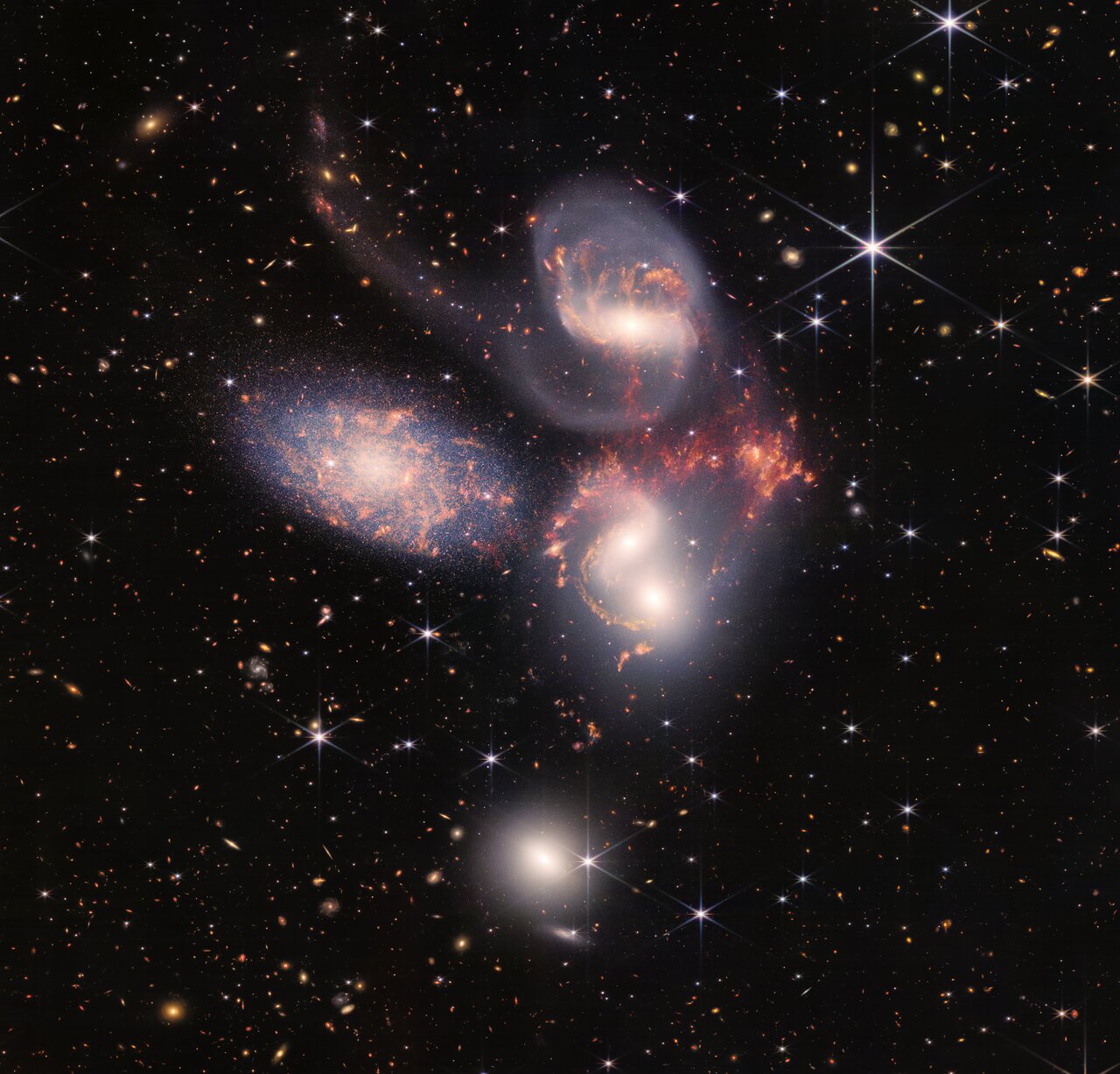
JWST Image of Stephan’s Quintet of Galaxies
Stephan’s Quintet of Galaxies in the Constellation Pegasus. This new infrared image from the JWST shows details that are shrouded by dust in visible light including large shock waves and tidal tails in four of the five galaxies, as well as previously hidden areas of star formation. The galaxy at the top of the image – NGC 7319 – contains a supermassive black hole 24 million times the mass of the Sun at its centre. (Click image to enlarge). Image Credit: NASA, ESA, CSA, STScI, and the Webb ERO Production Team
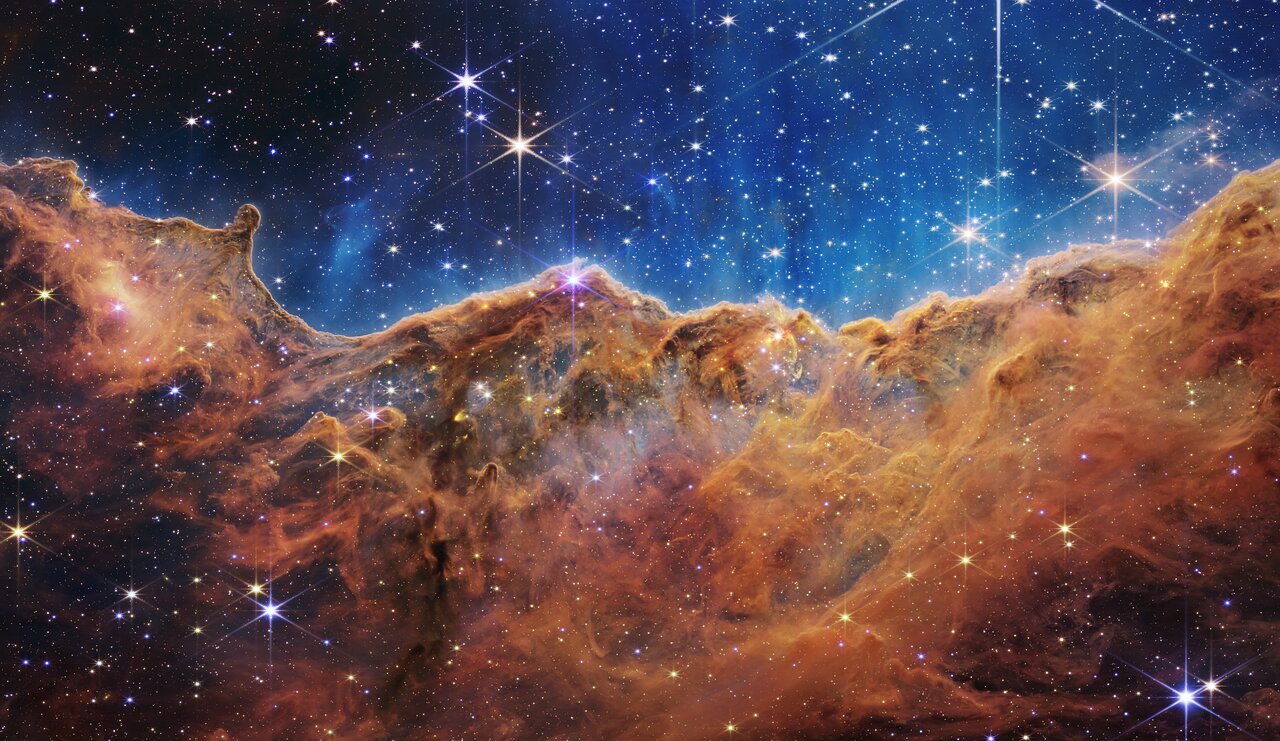
JWST Image of the Carina Nebula
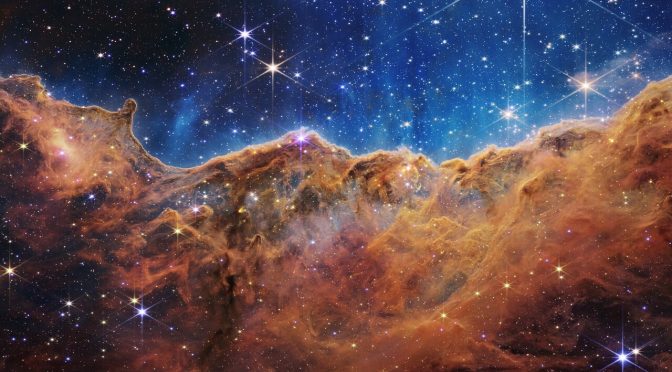
JWST NIRCam Image of the “Cosmic Cliffs” of the Carina Nebula in the constellation Carina revealing stellar nurseries and individual stars that are completely obscured by dust in visible-light pictures. (Click image to enlarge). mage Credit: NASA, ESA, CSA, and STScI
JWST Spectrograph of the exoplanet WASP-96 b
Transmission spectrum made from the JWST’s Near-Infrared Imager and Slitless Spectrograph (NIRISS) revealing the presence of water in the atmosphere of the hot gas giant exoplanet WASP-96 b, orbiting a sun-like star roughly 1,150 light-years away in the constellation Phoenix. (Click image to enlarge). Credit: NASA, ESA, CSA, STScI, and the Webb ERO Production Team

To read more about the JWST, see The James Webb Space Telescope.

To read more about these images, visit esawebb.org/news/weic2210/

Evidence of New Fundamental Force

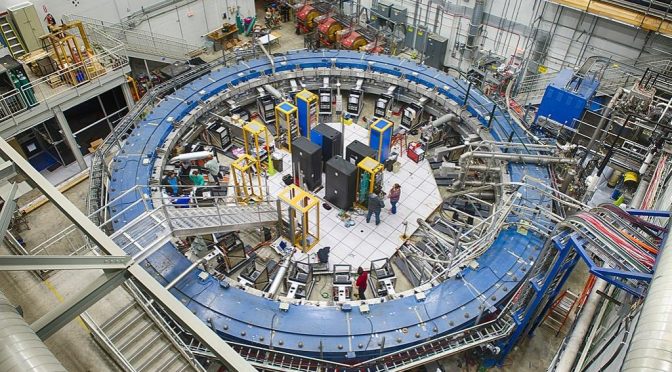
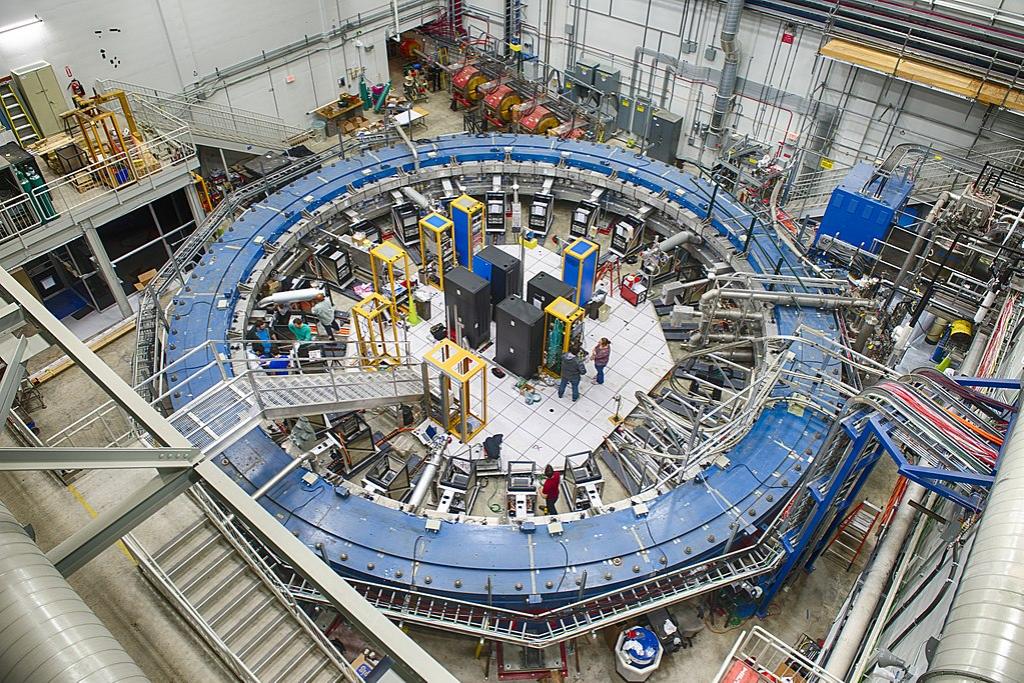
Magnetic storage ring at Fermilab
The 50-foot-diameter superconducting magnetic storage ring used in the Fermilab muon g-2 experiment – Credit: Reidar Hahn, Fermilab

The ‘Muon g-2’ experiment conducted at the Fermi National Accelerator Laboratory (also known as Fermilab) in the United States has provided strong evidence for the existence of a new fundamental force of nature.

We currently know of four fundamental forces, the strong and weak nuclear forces, the electromagnetic force and the force of gravity. This latest experimental evidence could be a step on the way to adding a fifth force to this list.

The experiment has been studying the behaviour of muons – particles similar to electrons but around 200 times more massive – as they wobble in response to a magnetic field.

A muon’s behaviour in these magnetic fields is determined by a quantity known as its ‘g-factor’, which is a measure of the strength of the particle’s own internal magnetic field. However, the muon’s wobble should also be influenced by the existence of what’s know as ‘quantum foam’. This is a host of virtual particles, predicted by quantum field theory to instantaneously pop in and out of existence in the vacuum of empty space.

The results of the Fermilab experiments show that the size of the effect of this quantum foam on the muon’s wobble is greater than predicted by the ‘Standard Model’ of particle physics – the theory describing the known fundamental forces in the universe (not counting gravity which doesn’t yet fit in with our understanding of quantum mechanics) and classifying all known elementary particles. This could mean that a new fundamental force or particle is affecting the muons’ behaviour.

So far the evidence for a new force is strong – around the ‘4.1-sigma’ level, meaning that there is around a one in a 40,000 chance that the result could be a statistical fluke. However more research will be needed to reach the 5-sigma level – a one in 3.5 million chance of the observation being a coincidence – that is required by the scientific community to claim a new discovery.

If it turns out that a new fundamental force needs to be added to the list, this could revolutionise our understanding of the universe, perhaps providing an explanation for problems with our current cosmological models such as the unknown nature of dark energy and dark matter.

To read more, visit https://news.fnal.gov/2021/04/first-results-from-fermilabs-muon-g-2-experiment-strengthen-evidence-of-new-physics/

First Image of a Black Hole

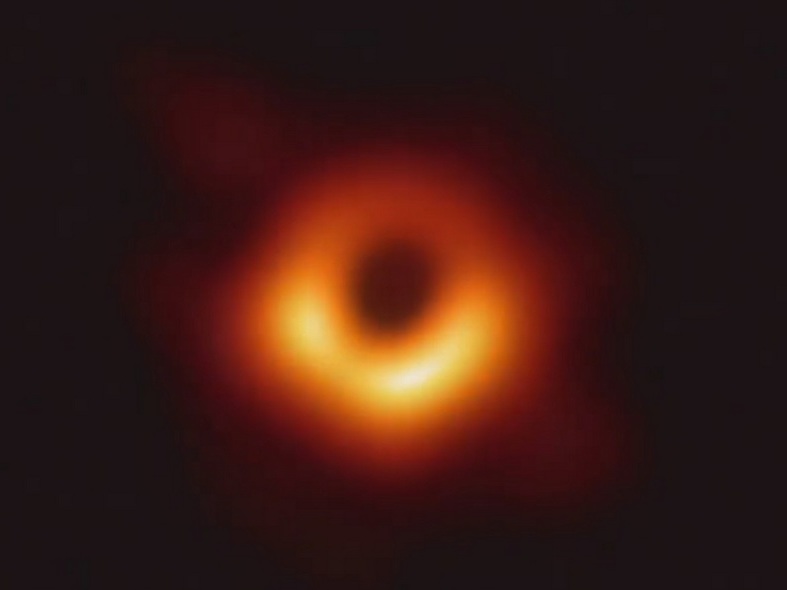
The first ever image of a black hole
The first ever image of a black hole, created using the Event Horizon Telescope, showing the black hole’s dark silhouette at the centre of its luminous accretion disk. Credit: Event Horizon Telescope Collaboration – Click to enlarge

A global network of radio telescopes known as the Event Horizon Telescope  (EHT) has produced the first ever image of the silhouette of a black hole.

The image shows hot luminous gas surrounding the black hole’s event horizon – the sphere beyond which light cannot escape the black hole’s gravitational influence.

The team responsible has worked for over a decade to improve upon the technique of Very Long Baseline Interferometry in order to capture the image. The resolution of a telescope is usually dependent upon the size of the dish, or aperture – usually equivalent to the width of the mirror or lens in an optical telescope or the the width of the dish in the case of a radio telescope. The technique of interferometry creates a much larger ‘synthetic aperture’ by linking the images from two or more telescopes together. The further apart the telescopes, the larger the synthetic aperture. The EHT’s synthetic aperture has a resolution equivalent to a dish with a diameter equal to the distance between Spain and the South Pole – where the two furthest apart telescopes in the array are located.

Five petabytes of data were used to construct the image. Because current internet speeds are not sufficient to handle this amount of data, it had to be physically transported to a central location from all eight sites in the EHT array.

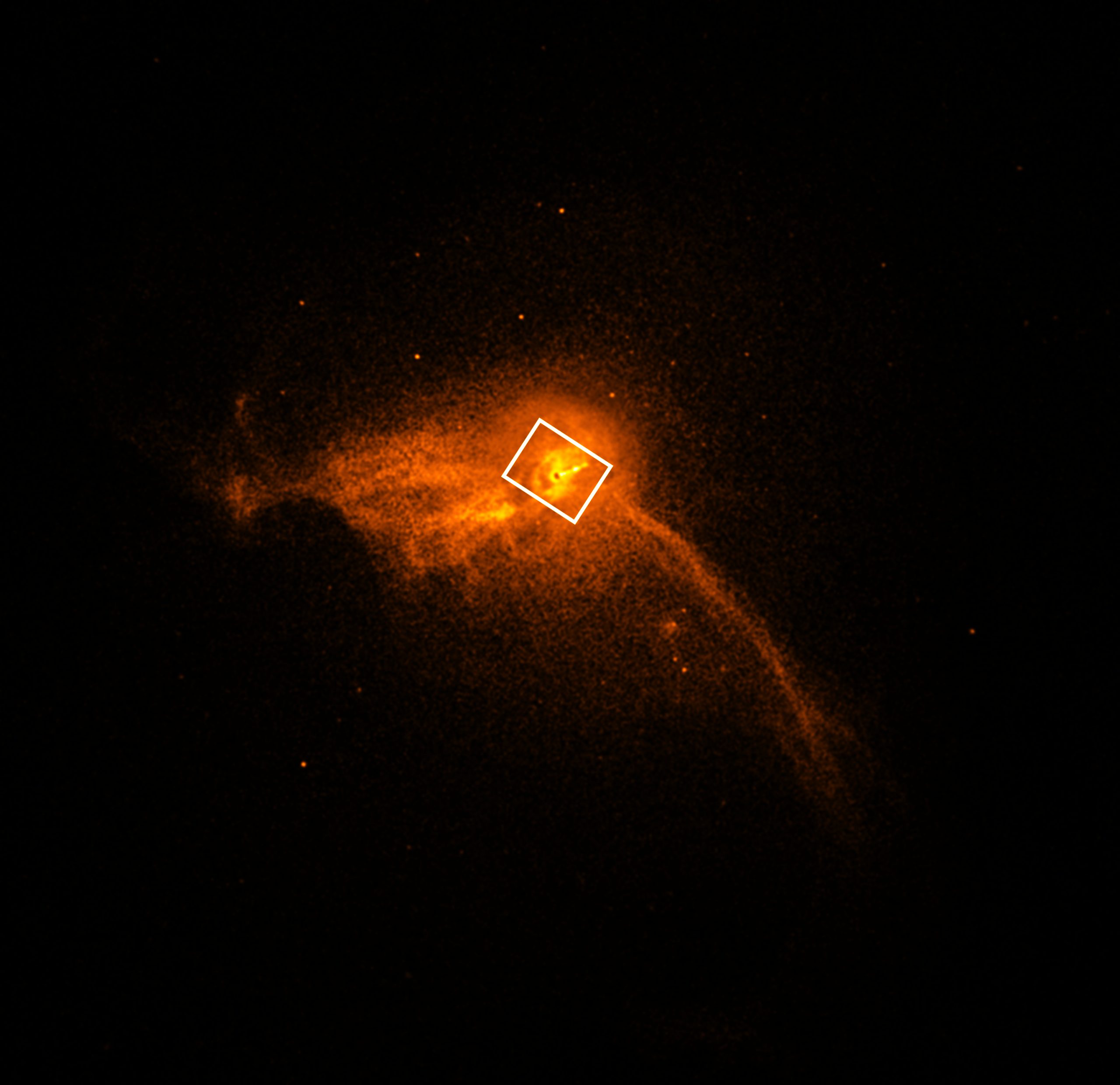
Image of luminous gas at the core of the M87 galaxy, marked with the position of the black hole and its accretion disk
A close-up of the core of the M87 galaxy, from the Chandra X-ray Observatory. Image credit: NASA/CXC/Villanova University/J. Neilsen – Click to enlarge

The black hole is located at the center of the M87 galaxy – a supergiant elliptical galaxy in the constellation of Virgo. Estimates for the mass of this black hole range from around 3.5 to 6.6 billion times the mass of the Sun.

The supermassive black hole is surrounded by a rotating accretion disk of ionized gas. The disk rotates at a velocity of roughly 1,000 km per second and has a maximum radius of around 0.2 light years, or around 12,000 Astronomical Units (where 1 Astronomical Unit (AU) is the equivalent to the average distance between the Earth and the Sun). The radius of the black hole’s event horizon – or Schwarzschild radius – is around 120 AU.

The black hole’s powerful magnetic field causes it to emit a narrow jet of ionised material from the accretion disk aligned with its axis of rotation. The material in this jet travels at relativistic speeds and reaches a distance of at least 5,000 light years from the black hole.

M87's relativistic jet
Hubble Space Telescope image showing the jet of subatomic particles streaming from the black hole at the center of the M87 galaxy. Credits: NASA and the Hubble Heritage Team (STScI/AURA) – Click to enlarge.

Cliffs of Ice Found on Mars

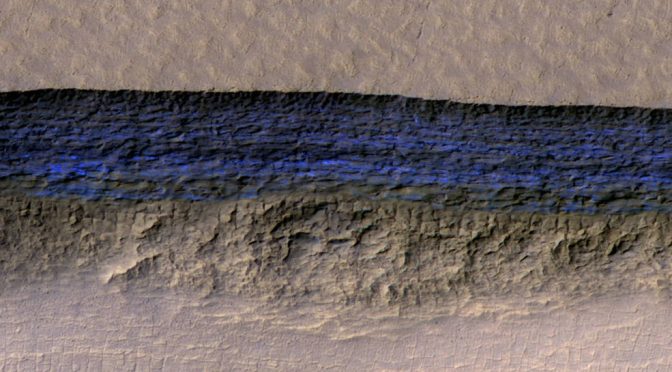
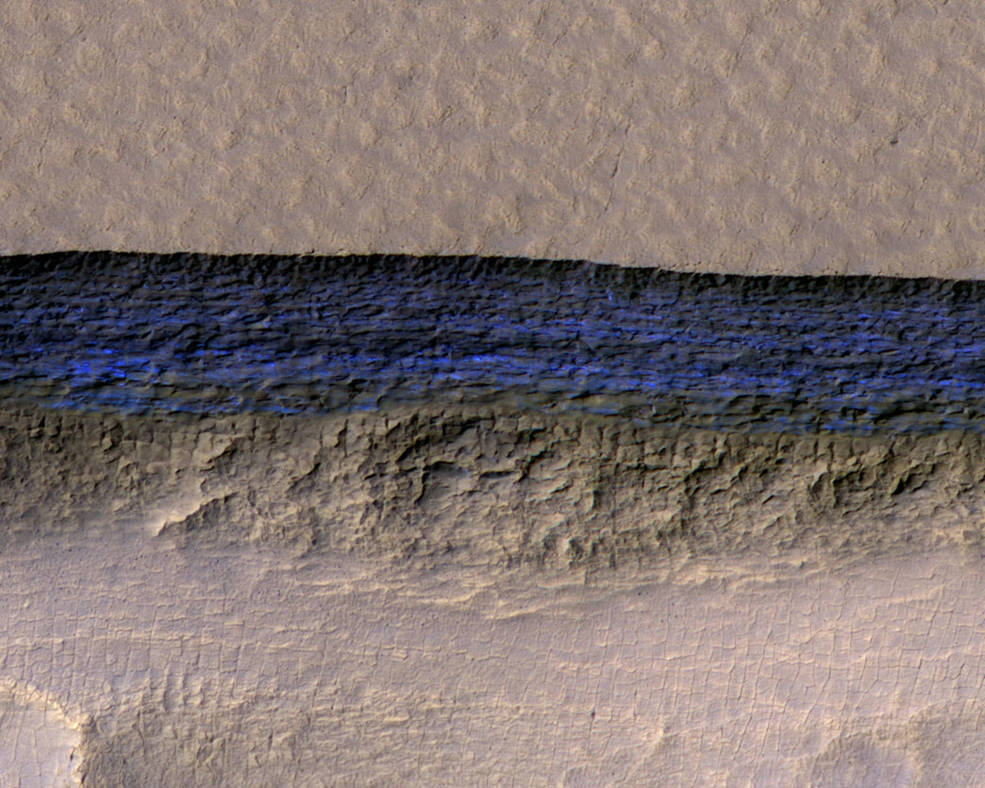
water-ice cliff on Mars
Enhanced-colour image, showing a water-ice cliff, or scarp, on Mars, taken with the High Resolution Imaging Science Experiment (HiRISE) camera on NASA’s Mars Reconnaissance Orbiter. The exposed ice is shown in blue dropping about 80 metres from the level ground in the upper third of the image. (Credits: NASA/JPL-Caltech/UA/USGS) – click to enlarge
Water ice deposits have been found in cliff-like structures known as ‘scarps’ at eight different sites on Mars, using the HiRISE camera on NASA’s Mars Reconnaissance Orbiter.

It has previously been shown that there is shallow ground ice under roughly a third of the Martian surface, detected with spectrometers and ground-penetrating radar from orbiting spacecraft. The exposed faces of these scarps provide us with a cross-sectional view though this ice, which is over 100 metres thick in some places. Continue reading Cliffs of Ice Found on Mars

Interstellar Object Discovered in Our Own Solar System

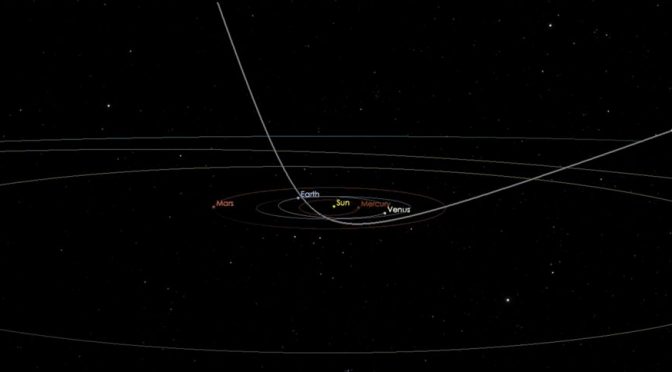
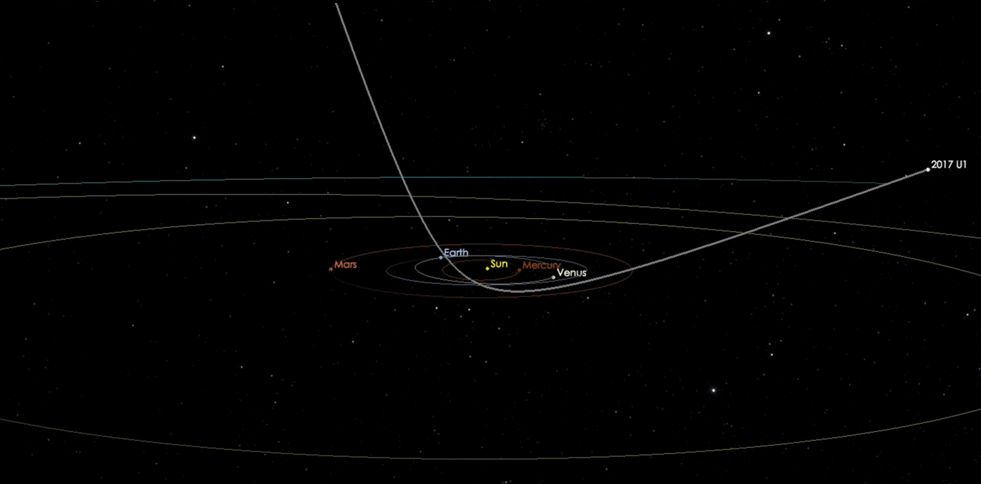
Oumuamua Trajectory
The trajectory of Oumuamua 1I/2017 U1 through our Solar System (credit: NASA/JPL-Caltech) – click to enlarge

On 19 October 2017, an astronomer at the Haleakala Observatory, Hawaii, spotted an object passing through our solar system on an unusual hyperbolic trajectory. The strange cigar-like shape of the object lead some to speculate that it could be the product of an extraterrestrial civilization. Continue reading Interstellar Object Discovered in Our Own Solar System

Seven Earth-Like Planets Found Orbiting TRAPPIST-1

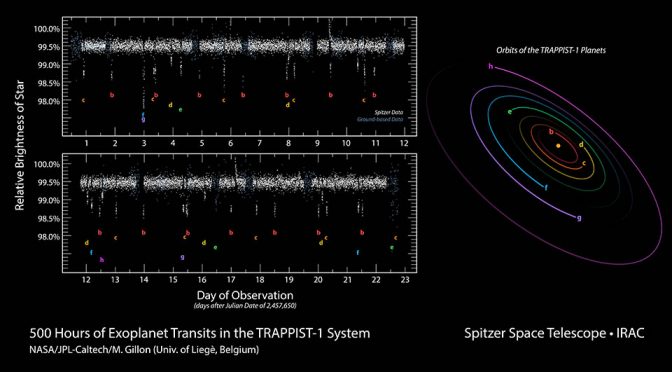
On 22 February 2017, astronomers announced that the faint Jupiter-sized ultra-cool red dwarf star TRAPPIST-1, in the constellation of Aquarius, is host to seven Earth-sized planets, all of which are within the stars’ ‘habitable zone’, where it is possible that liquid water could be present.

The exoplanets have not yet been imaged directly but were detectable due to the dimming of the light from TRAPPIST-1, as the planets transited across the face of the star.
Continue reading Seven Earth-Like Planets Found Orbiting TRAPPIST-1

Neutrino source pinpointed for first time

IceCube neutrino detector
The IceCube detector – a cubic kilometre of Antarctic ice threaded with sensitive light detectors.

The IceCube neutrino telescope in Antarctica, the Fermi gamma ray telescope in low earth orbit and an array of radio telescopes across the Southern Hemisphere, have been used collaboratively to pinpoint a neutrino source in deep space for the first time.
Continue reading Neutrino source pinpointed for first time

Gravitational Waves Detected

Gravitation wave discovery data
Visualisation of the gravitational wave event data from the two LIGO observatories in Hanford, Washington and Livingstone, Louisiana confirming the black hole merger. Both plots show the frequency of the event signal sweeping sharply upwards, from 35 Hz to about 150 Hz over two tenths of a second. From ‘Observation of Gravitational Waves from a Binary Black Hole Merger’ B. P. Abbott et al. (LIGO Scientific Collaboration and Virgo Collaboration) Phys. Rev. Lett. 116, 061102 – Published 11 February 2016

The first ever confirmed detection of gravitational waves has been announced by the Laser Interferometer Gravitational-wave Observatory (LIGO) at a press conference held in Washington DC at 10:30 EST on Thurday, 11 February 2016 .

LIGO’s detection of ripples in the fabric of spacetime has been heralded as one of the scientific breakthroughs of the century and promises to mark the  dawn of a new science of gravitational-wave astronomy.
Continue reading Gravitational Waves Detected